Temporary Access Management –
Commercial buildings in Wetherby regularly require temporary access for:
- contractors
- cleaning staff
- delivery teams
- maintenance engineers
- and external service providers
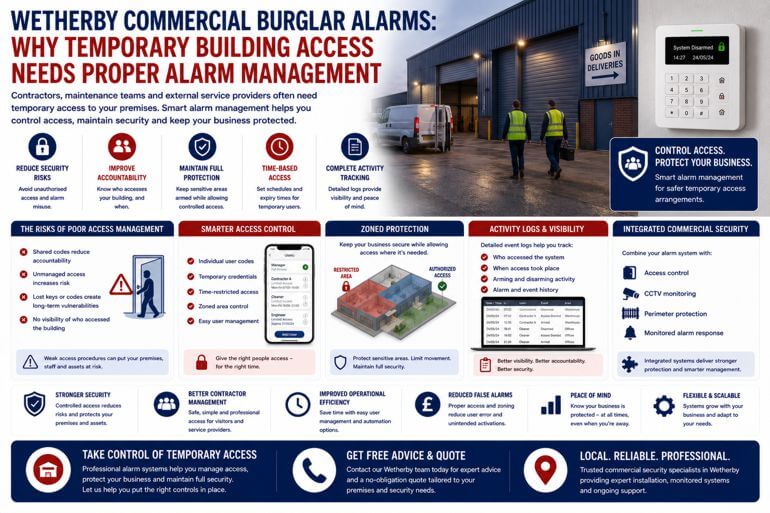
However, temporary access arrangements are often one of the weakest points in commercial security management. Even businesses with professionally installed burglar alarm systems can create unnecessary risks if alarm access procedures are not controlled properly.
Modern commercial burglar alarm systems are increasingly designed to manage temporary access more securely while maintaining full protection across the rest of the premises.
Temporary Access Can Create Security Gaps
Many businesses still rely on:
- shared alarm codes
- unmanaged keys
- or informal access arrangements
for temporary visitors.
This can lead to:
- unauthorised access
- alarm misuse
- poor accountability
- and increased security vulnerability
particularly outside normal operating hours.
Shared Alarm Codes Reduce Accountability
When multiple people use the same alarm code, businesses lose visibility over:
- who entered the premises
- when access occurred
- and who armed or disarmed the system
Modern systems increasingly support:
- individual user profiles
- temporary credentials
- and time-restricted access permissions
to improve accountability.
Contractors Often Need Access Outside Business Hours
Commercial premises frequently require:
- overnight cleaning
- maintenance visits
- IT servicing
- or emergency repairs
during periods when the building would normally remain fully armed.
Proper alarm management allows:
- controlled access
- isolated alarm zones
- and restricted movement
without compromising wider site security.
Zoned Alarm Systems Improve Control
Modern commercial alarm systems can divide premises into separate zones.
This allows businesses to:
- keep sensitive areas armed
- restrict contractor movement
- and maintain protection across unused parts of the building
while temporary visitors access authorised locations only.
Time-Based Access Reduces Risk
Some systems allow businesses to apply:
- scheduled access permissions
- temporary user codes
- and automatic expiry times
This prevents old access credentials remaining active indefinitely.
For example:
- a contractor may receive access only during specific hours
- or only for the duration of a project
Event Logs Improve Visibility
Commercial alarm systems often record:
- user activity
- arming events
- disarming times
- and access history
This creates better traceability if:
- incidents occur
- property goes missing
- or security concerns arise
Temporary Access Should Work Alongside Access Control
Many Wetherby businesses now integrate:
- burglar alarms
- access control
- CCTV
- and monitored security systems
to create more intelligent management of temporary access arrangements.
For example:
- door access events may correspond with alarm activity
- CCTV can verify attendance
- and restricted areas remain protected
Key Management Still Matters
Even modern alarm systems still rely on good physical security procedures.
Businesses should manage:
- keys
- fobs
- access cards
- and visitor credentials
carefully to avoid unnecessary risk.
Alarm Monitoring Adds Additional Oversight
Monitored alarm systems can provide additional awareness when:
- premises are accessed unexpectedly
- systems are unset outside approved hours
- or unusual activity occurs
This creates stronger out-of-hours visibility.
Security Policies Should Match the Alarm System
Technology alone is not enough.
Businesses should also maintain clear procedures covering:
- contractor access
- key handling
- visitor management
- and alarm operation
This helps reduce confusion and improve overall site security.
Commercial Security Requires Controlled Access
For businesses in Wetherby, temporary building access should never compromise wider commercial security.
Professionally managed burglar alarm systems help provide:
- stronger access control
- improved accountability
- reduced user error
- and safer contractor management
As businesses increasingly depend on multiple external service providers, smarter temporary access management is becoming an essential part of modern commercial security strategy.
Frequently Asked Questions
Can burglar alarm systems manage contractor access?
Yes. Modern systems can support temporary codes, scheduled access and zoned protection.
Why are shared alarm codes a problem?
Shared codes reduce accountability and make it difficult to track who accessed the premises.
Can alarm systems work with access control?
Commercial buildings in Wetherby regularly require temporary access for:
- contractors
- cleaning staff
- delivery teams
- maintenance engineers
- and external service providers
However, temporary access arrangements are often one of the weakest points in commercial security management. Even businesses with professionally installed burglar alarm systems can create unnecessary risks if alarm access procedures are not controlled properly.
Modern commercial burglar alarm systems are increasingly designed to manage temporary access more securely while maintaining full protection across the rest of the premises.
Temporary Access Can Create Security Gaps
Many businesses still rely on:
- shared alarm codes
- unmanaged keys
- or informal access arrangements
for temporary visitors.
This can lead to:
- unauthorised access
- alarm misuse
- poor accountability
- and increased security vulnerability
particularly outside normal operating hours.
Shared Alarm Codes Reduce Accountability
When multiple people use the same alarm code, businesses lose visibility over:
- who entered the premises
- when access occurred
- and who armed or disarmed the system
Modern systems increasingly support:
- individual user profiles
- temporary credentials
- and time-restricted access permissions
to improve accountability.
Contractors Often Need Access Outside Business Hours
Commercial premises frequently require:
- overnight cleaning
- maintenance visits
- IT servicing
- or emergency repairs
during periods when the building would normally remain fully armed.
Proper alarm management allows:
- controlled access
- isolated alarm zones
- and restricted movement
without compromising wider site security.
Zoned Alarm Systems Improve Control
Modern commercial alarm systems can divide premises into separate zones.
This allows businesses to:
- keep sensitive areas armed
- restrict contractor movement
- and maintain protection across unused parts of the building
while temporary visitors access authorised locations only.
Time-Based Access Reduces Risk
Some systems allow businesses to apply:
- scheduled access permissions
- temporary user codes
- and automatic expiry times
This prevents old access credentials remaining active indefinitely.
For example:
- a contractor may receive access only during specific hours
- or only for the duration of a project
Event Logs Improve Visibility
Commercial alarm systems often record:
- user activity
- arming events
- disarming times
- and access history
This creates better traceability if:
- incidents occur
- property goes missing
- or security concerns arise
Temporary Access Should Work Alongside Access Control
Many Wetherby businesses now integrate:
- burglar alarms
- access control
- CCTV
- and monitored security systems
to create more intelligent management of temporary access arrangements.
For example:
- door access events may correspond with alarm activity
- CCTV can verify attendance
- and restricted areas remain protected
Key Management Still Matters
Even modern alarm systems still rely on good physical security procedures.
Businesses should manage:
- keys
- fobs
- access cards
- and visitor credentials
carefully to avoid unnecessary risk.
Alarm Monitoring Adds Additional Oversight
Monitored alarm systems can provide additional awareness when:
- premises are accessed unexpectedly
- systems are unset outside approved hours
- or unusual activity occurs
This creates stronger out-of-hours visibility.
Security Policies Should Match the Alarm System
Technology alone is not enough.
Businesses should also maintain clear procedures covering:
- contractor access
- key handling
- visitor management
- and alarm operation
This helps reduce confusion and improve overall site security.
Commercial Security Requires Controlled Access
For businesses in Wetherby, temporary building access should never compromise wider commercial security.
Professionally managed burglar alarm systems help provide:
- stronger access control
- improved accountability
- reduced user error
- and safer contractor management
As businesses increasingly depend on multiple external service providers, smarter temporary access management is becoming an essential part of modern commercial security strategy.
Frequently Asked Questions
Can burglar alarm systems manage contractor access?
Yes. Modern systems can support temporary codes, scheduled access and zoned protection.
Why are shared alarm codes a problem?
Shared codes reduce accountability and make it difficult to track who accessed the premises.
Can alarm systems work with access control?
Absolutely. Many commercial systems integrate alarms, CCTV and door access together.